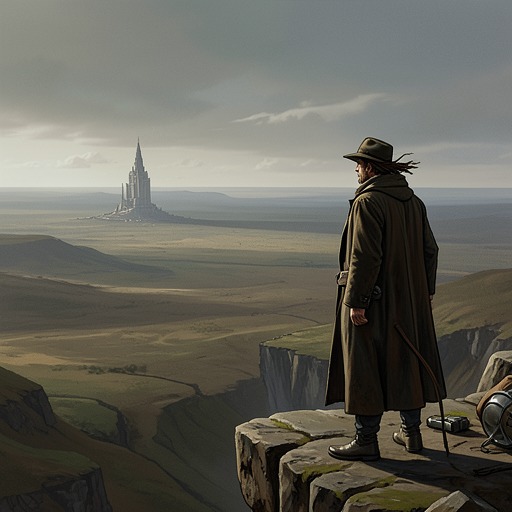
Post-human Beetle Race
The Colour Out of SpaceThe Post-human Beetle Race is the civilization that follows humanity in the distant future of Earth, and the planned refuge for the minds of the Great Race of Yith when catastrophe overtakes the elder world. Its place in this history overturns a human-centered view of terrestrial dominance: humanity is one temporary species among many, while the beetle age becomes a new stage in the passage of intelligence across deep time.
Identity and Place in Earth’s Succession
The Post-human Beetle Race is described as a hardy coleopterous species that will succeed mankind. The account places it within a succession of dominant terrestrial races extending across immense spans of time, rather than treating humanity as the planet’s final or defining life-form. The Great Race’s records and projections encompass beings that arose long before humanity and those that will appear after it; the beetle civilization belongs to that future history.
The narrator’s dreams present the beetles as an actual future people, not merely as an image of insects. Among the minds held in the Great Race’s age are five minds from the hardy coleopterous species immediately following mankind. Their presence makes the future race part of the Great Race’s own intertemporal world: individuals from a later age can be drawn into its society through the same exchange of minds that reaches across other periods.
The Great Race’s Future Refuge
The beetle civilization has a particular significance in the Great Race’s plans. Foreseeing a coming disaster, the Great Race intends to transfer its keenest minds en masse into the bodies of this future species. The change of bodies is presented as a means of surviving a peril that the Yithian projections locate in the elder world, not as a routine migration or a voluntary exchange between contemporaneous peoples.
The danger behind the plan is associated with a final successful irruption by the Elder Things. The Great Race’s projections indicate that the beetle age will come after the feared event, when the Elder Things are no longer alive. The beetle bodies therefore offer a safer future destination for minds escaping the threatened period. Their importance to the Great Race lies in the possibility of carrying its accumulated intelligence beyond the destruction of its own age.
This transfer is not described as preserving the Great Race’s original bodies or world. Rather, its minds will inhabit members of another species, while displaced beetle minds are among those drawn into the Great Race’s earlier era. The account thus makes the boundary between civilizations permeable at the level of consciousness, even as their bodies and historical periods remain distinct.
Later Migrations and Narrative Significance
The beetle age is itself only one stage in a longer future. After the Great Race’s minds have moved into beetle bodies, they are expected eventually to migrate again, this time to the bodies of bulbous vegetable entities on Mercury as Earth’s span draws toward its end. The narration also describes later races remaining on the cold planet and burrowing toward its horror-filled core. The beetle civilization is therefore neither the terminus of life nor a final sanctuary, but a turning point in an ongoing sequence of survival, succession, and displacement.
The account of this future reaches the reader through the narrator’s dreams and the knowledge he recalls from the Great Race’s age. He says that the fate of humanity, as hinted at by post-human beings, affected him so deeply that he will not set it down; he does, however, recount the beetles’ place in the Great Race’s escape plan. This partial disclosure gives the species a double narrative function: it makes the eventual succession of humanity imaginable, while showing that even the most powerful civilization in the story can survive only by entering another species’ future bodies.